

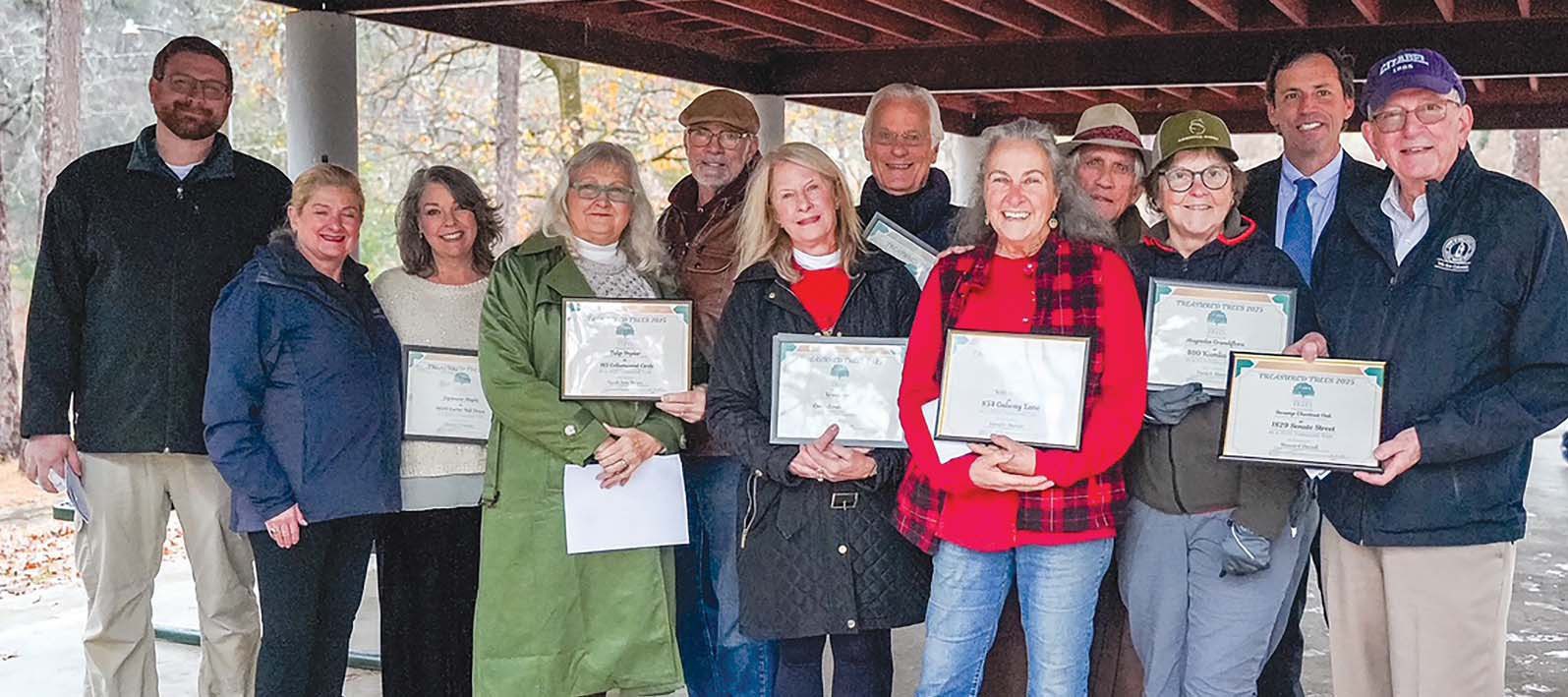
The City of Columbia celebrated the 2025 Treasured Tree Ceremony December 5, honoring some of the most significant and historic trees in the community. Photo contributed by Brian Neiger
Around 1 p.m. on a nasty and wet December 5, an Arbor Day crowd gathered under a picnic shelter at Earlewood Park in downtown Columbia. The folks were there to announce the winners of the 20th Treasured Trees Recognition. The event began in 2005 and has celebrated winning entries every year since, except in 2020, due to COVID.
Treasured Trees was established when Susie Heyward, who was on the Columbia Green Board, saw a tree calendar from Asheville and decided Columbia needed the same thing. After consulting with other board members and talking with the folks in Asheville, she decided Columbia needed an inventory of trees in order to develop a calendar. So Treasured Trees was born.
Susie’s appreciation of trees began at an early age. When she was escaping the wrath of her grandmother’s switch she would climb the giant Magnolia tree in the yard and wait for her to cool down or grandpa to come home and save her.
She plans to remain as a partner with the Forestry Division “until the city tells me to go home.” Her focus is on getting everyone to “appreciate trees and what they do for us.” Susie would also like to see an educational component in plant stores to help people decide which tree they want to plant.
“Those twigs they sell at plant stores don’t show people what the tree will look like when it grows and blooms in the spring,” Susie says.
Noting the city’s focus on Arbor Day, she reminds potential tree worshipers,
“Arbor Day is celebrated as the first day to plant a tree, not the only day. We can plant trees in Columbia through February.” Susie also wants to remind everyone to take Treasured Tree contest pictures in the spring when they’re in bloom. The contest opens each year in September, but the trees are more impressive in the spring.
Columbia’s superintendent of Forestry and Beautification, Brian Neiger, says, “The program creates a community buy-in to the idea of an urban forest. You never hear people talk about trees they bought with their house, but you always hear them talk about the ones their grandparents planted. They are a link to their ancestors.” As the planet changes, it becomes more important to realize planting a tree is a simple and effective way to help.
Treasured Trees is a public-private partnership between the City of Columbia, the Columbia Garden Club, and the Columbia Tree and Appearance Commission. The program’s purpose has always been simply to recognize trees that have exceptional value.
There are many interpretations of what exceptional value might be. Their size, age, historical significance, and unique characteristics make many trees special and in some cases treasured. This title would also apply to trees that have positively impacted one’s community.
It’s also important to note that the Treasured Trees Program does not provide any legal protection for the trees. In fact, there have been instances in which trees recognized by the program were removed within a year of their nomination.
Exceptional value, like love, can be interpreted in many ways. While the preceding paragraph addresses unsavory possibilities of this program, it is also important to address how simple the contest requirement is while also acknowledging a wide range of definitions.
According to a Forestry Division spreadsheet and some Alabama Redneck math, there have been 201 trees and tree groves awarded the Treasured Tree Title since this program started. Trees from Congaree National Park, Sesquicentennial State Park, Belser Arboretum, the Governor’s Mansion, and the Robert Mills House have been included.
Trees located at USC, Columbia College, and local elementary and high schools have been recognized, along with state buildings, cemeteries, and Kohl’s. In addition to Columbia, Irmo, Chapin, Lexington, Batesburg, Hopkins, Cayce, Forest Acres, Elgin, Eastover, and West Columbia have scored a Treasured Tree, and so have neighborhoods of all shapes and sizes.
Among the reasons the Treasured Trees were nominated this year were longevity; resistance to hurricane winds; extracting love and respect from the neighborhood; putting on year round displays of changing color; displaying powerful examples of age, size, shape, and historic significance; and overcoming human planting errors. In addition, a massive Willow Oak details a story of partnership—from first date to romance to lifelong dedication. Both to the natural world and each other—Treasured Trees indeed.
The trees considered Treasured are also varied, with nearly every area species included in the Treasured Trees list of winners. Speaking of winners, the 2025 winners, announced December 5 as part of Columbia’s Forestry and Beautification Department’s Arbor Day celebration, include a Swamp Chestnut Oak located at 1829 Senate Street, nominated by Howard Duvall; a Southern Red Oak on 4201 Blossom Street and a Magnolia Grandiflora on 400 Kamlia Drive, nominated by Leyla and Patrick Mason; a Japanese Maple on 4620 Carter Hill Drive, nominated by Eleanor Grande;, a Magnolia Grandiflora, Flowering Dogwood, and Water Oak, all located at Confederate and Bull near the Old Confederate Cemetery, nominated by Denise Wellman; a Tulip Poplar on 165 Collumwood Circle, nominated by Sarah Jane Byars; and a Willow Oak, located on 854 Galway Lane at Hammond School, nominated by Jennifer Mancke.
“The clearest way into the Universe is through a forest wilderness.”
~John Muir
The Treasured Trees Program seeks to document and preserve trees that have significant value to the greater community and promote the awareness, benefit, and value of trees to the community. Nominations for the next round of Treasured Trees will open in September 2026, and winners will be announced early December.
For more information, visit publicworks.columbiasc.gov/forestry-and-beautification.
Loading Comments