

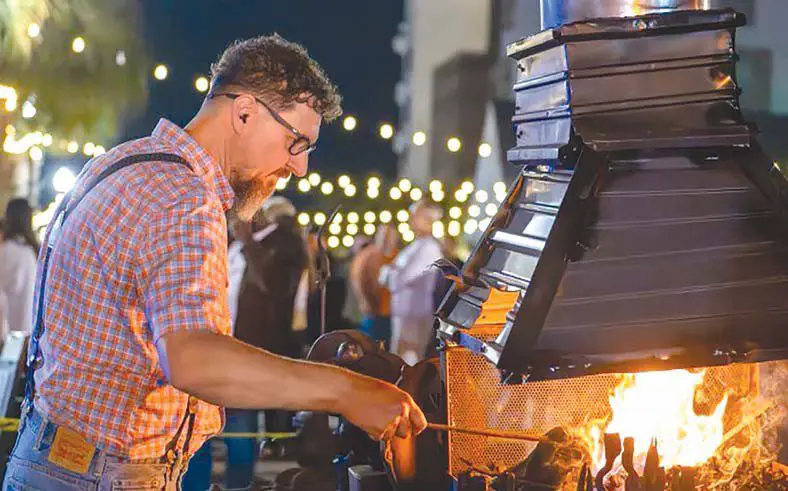
Jason Jaco practices the ancient craft of blacksmithing.
Jason Jaco is among several local craftsmen and organizations keeping the art of blacksmithing alive and well.
Around 3,000 years ago, the Iron Age was ushered in by the Hittites, who discovered how to forge and temper iron ore. This new technique allowed craftsmen to make tools and weapons superior to the stone implements being used at that time. After the Hittite Civilization collapsed, all those blacksmiths moved to new lands and carried the Iron Age with them.
Molding iron into usable tools and weapons and repairing those same implements remained a necessary skill for several centuries, until the Industrial Revolution in the Mid 1800s. Mechanized production and the replacement of horses as necessary transportation slowly killed the demand for local blacksmiths. Mechanized factories needed metal workers and offered former blacksmiths jobs.
By the 1960s, local blacksmiths had become increasingly harder to find. Few local communities needed a smithy for anything other than shoeing an ever decreasing herd of horses. Modern blacksmiths began reinventing themselves as farriers, skilled tradespersons who trimmed and balanced horses’ hooves and fit and applied horseshoes. Actual blacksmiths were a disappearing breed.
Traditional blacksmiths were only visible on television shows. Westerns were the primary fare for most television viewers during that medium’s early years. Most TV blacksmiths were stereotypically large, strong, slow-witted individuals, who handled horses and repaired anything metal— not an appealing role model.
Jason Jaco is part of a movement to expose the craft of blacksmithing to the public.
He grew up around his grandfather’s body shop on Texas Street in the Olympia-Grandby area and explored, studied, and pilfered anything that interested him.
“I bought the place from my folks around 2001. As a kid I would come out here and just plunder. There were interesting things stacked up everywhere. He built this place,” he says.
According to Jason, his mother remembered sitting on the steps watching her mom hand cinder blocks to her dad, James “Peg” Hall, who cemented them in place.
“It’s been here since. So, that was the catalyst. I always knew I liked this place. There was something about it,” Jason said.
After Jason bought the place he initially used the shop for woodworking and other personal projects. After getting a maintenance job nearby, he started utilizing the space for fabricating and welding projects at work. He eventually became adept at creating shapes with the welding machine and began experimenting with metal art.
A 2009 encounter with a blacksmith named Heyward Haltiwanger got Jason interested in fashioning metal on a forge. He began immersing himself into using a hot fire and blacksmithing tools he crafted to reshape metal.
Haltiwanger was raised in Chapin. His family lived on land grant property signed by King George II.
“We lived on a small farm on a dirt road away from any community,” says Haltiwanger.
Having few nearby friends and lots of energy, young Heyward dragged his grandfather’s rivet forge from his shop and began trying to find good uses for it.
Most farmers in the early ’60s had a rivet forge to do some of the repair work that blacksmiths had once done.
“Henry Ford hired former blacksmiths to do metal work at Ford Factories so there were few left,” said Haltiwanger.
At 14, Heyward started teaching himself to be a blacksmith. He says, “It took me forever to learn basic things. There was nobody to ask for advice.”
Slowly learning traditional era tool making, forging and other forgotten skills like soap making eventually brought attention to Heyward. He began sharing his talent with nearby folks.
Barry Myers, a charter member of the Philip Simmons Artist Blacksmith Guild (PSABG) contacted Heyward and got him involved with the guild.
“I started learning correct techniques and skills real fast,” said Heyward.
Before long he was demonstrating the “Period Correct skills” he was perfecting and sharing proper techniques with interested folks.
“Lots of people wanted to learn. It was interesting work. Someone told me that working with metal makes you live longer. You can be treated like a dog all day long then start hitting hot metal and it relieves stress,” he says.
While exhibiting his capabilities at the South Carolina State Museum in Columbia, Heyward met Jason and they developed a friendship. While conducting beginner classes in Lexington for PSABG, Heyward had Jason demonstrating techniques for the students.
As his forging ability increased Jason experimented with more intricate pieces.
“Most of the things that I’ve made have been for other people to give as gifts, and I enjoy seeing their reaction to things I’ve made for them,” he says. Forging a piece of art that brings enjoyment to people is at the heart of what Jason does as well. It’s close to his heart. Spreading the word about artistic possibilities for blacksmiths.
Jason is a member of PSABG, a 501(c)(3) nonprofit organization started in 1994 in South Carolina with about 30 charter members.
Originally known as the South Carolina Artist Blacksmith Association (SCABA), the organization was initially mentored by Philip Simmons, the legendary Charleston Blacksmith famous nationwide for his skill at creating beautiful pieces from iron and steel, especially decorative gates and fences.
In 1998, the organization’s name was changed to honor Simmons while he was still alive. PSABG now has around 200 members located in South Carolina and a few from surrounding states. The guild was organized exclusively for educational purposes to encourage and facilitate the training of blacksmiths, expose the blacksmith craft to the general public, and serve as a center of information about blacksmithing. Jason is also a member of the Artist Blacksmith Association of North America.
He participates each spring with the 701 Center for Contemporary Art, located in the village of Granby/Whaley. The center also hosts Columbia Open Studios, an annual event where artists open their studios and workshops to tours, sometimes inviting other artists to share their talents along with the presenting artist.
When asked what the most important part of his outreach is, Jason says, “I like to focus on how things are created and demonstrate traditional techniques. I do have power tools that I can use because I’m getting older and need them, but I can still demonstrate and make all these things by hand.”
Jason wants those learning smithing techniques, and also any other artistic endeavor, to initially focus on basic skills and let repetition increase one’s expertise.
“Lots of people get anxious and skip over beginning fundamentals. It’s noticeable later on when they’re trying to do more things,” he says.
That’s sound advice for anyone using their hands to demonstrate an emotion.
For more information on Jason Jaco’s work or blacksmiths in general, visit www.philipsimmonsartistblacksmithguild.com.
Loading Comments