

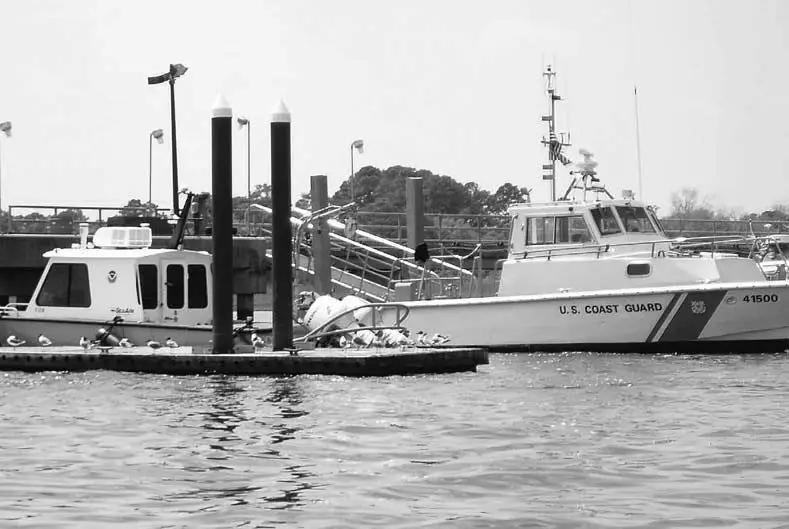
At Georgetown we passed the U.S. Coast Guard station.
Editor’s Note: At the request of his readers and in memory of Warner M. Montgomery, Ph.D, we will continue to publish his Adventure Travel stories for the time being.
“I’ve always wanted to take my boat from Brown’s Landing to Debordieu,” said John Jackson, former owner of Jackson Camera Stores and my Horrell Hill neighbor. “Every time I go to the beach and cross the Santee River at Brown’s Landing, it has looked so tempting.”
When John asked me to accompany him on the Santee River trip, he didn’t know about my family connection to the river. My Scots–Irish ancestors came up the river to Williamsburg County, and I had always wanted to trace their 1750 journey. So the trip was meaningful to both of us—passion for him, geneology for me.
We drove with our wives, Linda and Lee, to Brown’s Landing where we met John and Lee’s daughter, Lee Anne, and her husband, Jim Stoddard, and Ronney and Sylvia Dixon. At 11 a.m. the men launched the boats, and the women drove on to Debordieu (Debby Do). After all… It was a man’s venture.
The Santee River begins at the junction of the Congaree and the Wateree Rivers at the 601 bridge. It emerges from the Lake Marion dam into its ancient river bed and eventually joins the Pee Dee and the Waccamaw Rivers to form Winyah Bay at Georgetown.
Between Brown’s Landing and the 701 bridge, we witnessed the cauldron where the meandering blackwater river meets the Atlantic tide. The flow stops, and the water becomes brackish. The moss–laden, cypress swamps give way to antebellum rice fields now peppered with modern mansions and docks lined with ocean–going yachts.
It was a Friday, but nevertheless, I was surprised to see so few boats and fishermen. We almost had the calm, placid river to ourselves.
As we passed under the Highway 17 bridge and entered Winyah Bay, the wind picked up and the waves hindered our progress. Still no fishing boats. Johnny knew the way to Debordieu, but Jim followed his GPS, just in case.
The freighter lanes were empty, thank goodness. We moved as close to the shore as we dared weaving our way through the barren islands and into Jones Creek, all of which was part of a National Wildlife Refuge. Bald eagles flew in and out of the tallest trees. A few porpoises surfaced, checked us out, and disappeared.
The creek was peaceful: still water, red–wing blackbirds clinging to tall grass, fiddler crabs scuttering about, pelicans skimming the sand dunes, and seagulls diving into the water.
Our wives met us at the dock, and we loaded the boats. The adventure was complete. The sailors had returned safely and were rewarded with a shrimp feast. Ah, the good life!
My Scots–Irish ancestors emigrated to America, sailed up the Black River and settled in Williamsburg County 250 years ago. Now I have somewhat of an idea what those pioneers may have seen and felt. I have benefitted from the fortitude of good old Samuel Montgomery.
Loading Comments